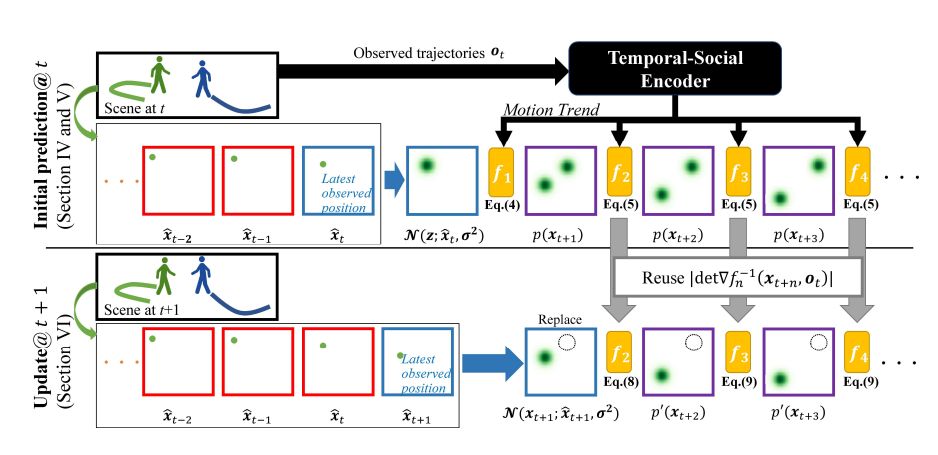
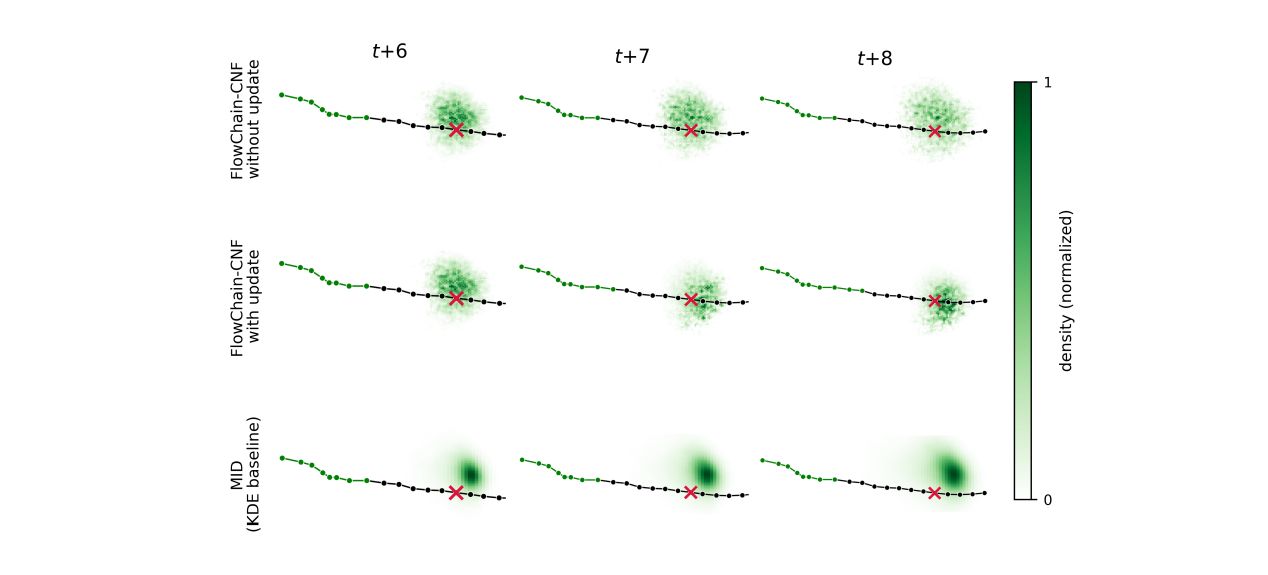
Sequential conditional density estimation underlies many safety-critical decision systems, where computational efficiency must be balanced against precise probabilistic forecasts of future states. We address this requirement in the context of human trajectory prediction, a representative application in autonomous driving and social robotics, and propose FlowChain, a normalizing-flow architecture that estimates a sequence of future spatial densities. FlowChain employs a chain of conditional continuously-indexed flows (CIFs), which provide high expressivity and enable analytical density evaluation with only a marginal approximation error. Unlike generative models that rely on costly post-hoc approximations such as kernel density estimation, this analytical approach removes the sample budget that governs the accuracy-runtime trade-off of sample-based estimation: it matches the best density accuracy any baseline reaches at any budget, at an order of magnitude less computation. By relaxing the rigid distributional assumptions of Gaussian-mixture based estimators, FlowChain achieves higher accuracy as measured by log-likelihood and an entropy-regularized Sinkhorn distance. A key innovation is its capability for submillisecond updates: by incorporating the latest observed position while reusing previously computed flow transformations and their log-det-Jacobians, which encapsulate the underlying motion trend, the model can refine density estimates in less than one millisecond. We formulate this update as self-normalized importance reweighting of a cached particle set and quantify the conditions under which the approximation holds. Experimental results demonstrate that FlowChain attains trajectory prediction accuracy competitive with, though on ETH/UCY not uniformly matching, state-of-the-art trajectory-sampling methods, while offering distinct advantages in the accuracy and speed of explicit density estimation and fast recursive updating, which are the primary contributions of this work. Our code is publicly available at https://github.com/meaten/keepflow .
@article{
  author  = {Takahiro Maeda and Norimichi Ukita},
  title   = {Continuously-Indexed Flows for Fast Inference and Updating of Trajectory-Prediction Densities},
  issn    = {-},
  url     = {https://},
  journal = {Neurocomputing},
  year    = {2026}
}